
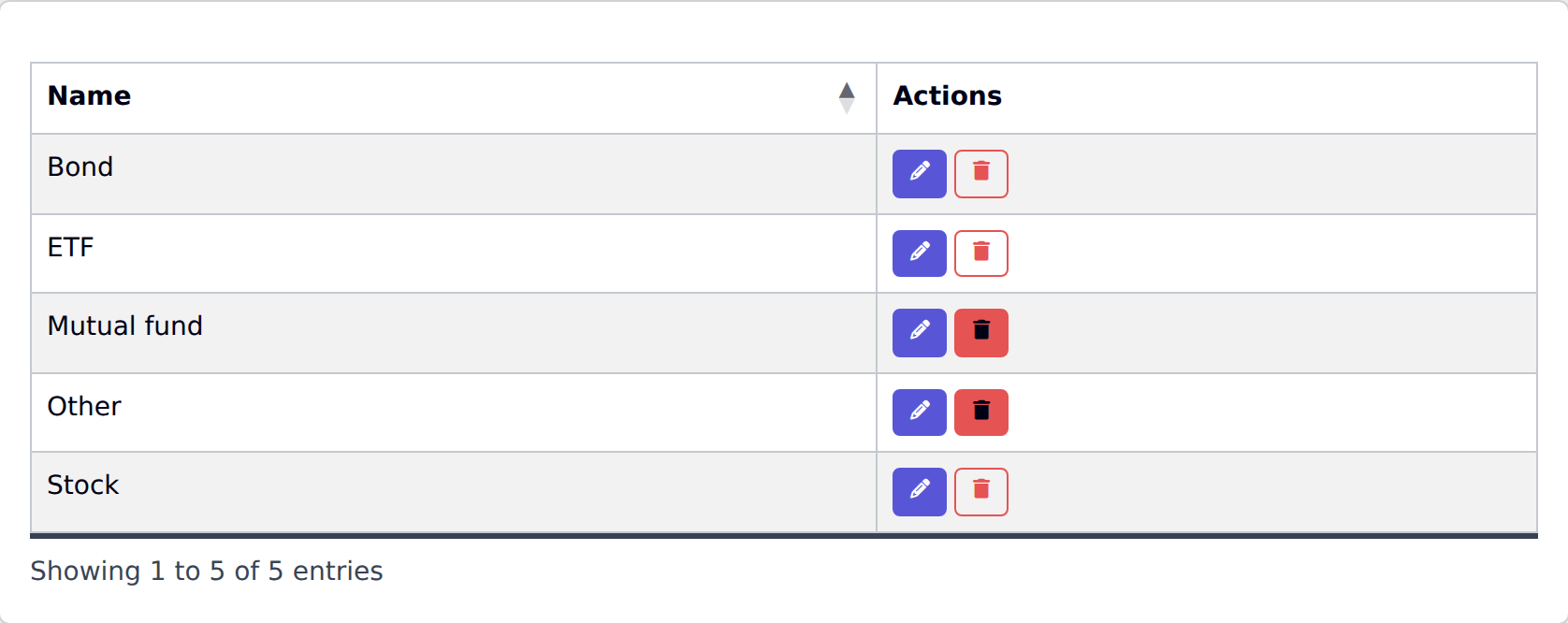
A growing investment list needs structure
When you track only one or two investments, a flat list is enough. But as your portfolio grows - stocks, funds, ETFs, bonds - the list becomes harder to interpret without some higher-level organization. Knowing you own ten holdings is less useful than knowing which are earmarked for retirement, which provide dividend income, and which are more speculative.
Investment groups in YAFFA solve this with a single intentional layer of organization. Each group is a label you define, and every investment you create is assigned to one of them. The result is a portfolio structure that reflects how you actually think about your holdings.
What investment groups help you do
See your portfolio at the right level of detail.
Instead of a flat list of symbols and fund names, you see holdings organized by strategy or purpose - making it easier to assess your overall allocation at a glance.
Build a deliberate setup from the start.
Investment groups are created before investments, which encourages you to think through how you want to organize your portfolio before adding individual holdings. A considered structure from day one stays useful as your positions multiply.
Support long-term planning.
Grouping holdings by purpose - retirement, emergency reserve, speculative growth - makes it easier to review your broader allocation intentionally and notice when the balance between groups drifts from your original intent.
Rename or reorganize safely at any time.
Renaming a group updates it everywhere without affecting any investment data or transaction history. Your records stay intact while the structure adapts to how your thinking has evolved.
Remove groups you no longer need.
Once no investments are attached to a group, it can be deleted cleanly. If holdings still depend on it, YAFFA prevents the deletion and explains why - so you never accidentally remove a structural reference that investments still rely on.
Investment groups are organizational, not financial
An investment group does not hold value, generate returns, or affect any calculation. It is a pure organizational label - one level of meaningful hierarchy above the investment list. All the financial logic stays in your individual investments and their associated transactions; the group just makes those investments easier to understand and navigate.
Similar to account groups, applied to your portfolio
If you already use account groups to organize your banking and savings accounts, investment groups follow the same pattern - one extra level of organization that keeps a growing list readable. Create as many or as few groups as you need, name them however makes sense to you, and adjust the structure freely as your financial goals evolve.